
Use the CygNet DDS Data Group Copy utility (DdsDataGroupCopy.exe) to copy data groups from one remote device to others within the same Device Definition Service (DDS). You can make several different kinds of changes in a single copy action, including updating one or many data groups within a single remote device, selected remote devices, or all remote devices of a certain type; deleting replaced data groups; and updating UDC mappings on destination data groups.
Best practice recommends that you first perform a copy in Test Mode Only. This produces a report at the bottom of the CygNet DDS Data Group Copy dialog box listing what changes would occur upon execution, and gives you the opportunity to make any necessary adjustments before proceeding.
The CygNet DDS Data Group Copy utility file (DdsDataGroupCopy.exe) is stored in the CygNet\Utilities directory on your host server.
Note: If you want to make similar changes to commands, see CygNet DDS Command Copy Utility.
To install and launch (start) the application or utility using version management:
-OR-
Alternatively, browse to the CygNet\Utilities directory using Windows Explorer and double-click the program icon. You can also start an application or utility from a command line. These methods do not provide version management.
The CygNet DDS Data Group Copy dialog box appears.
|
|
| Sample CygNet DDS Data Group Copy Dialog Box |
To successfully copy data groups, the facility "Ordinal" value must be the same for both the source and target devices, before using the utility. To verify a device's facility ordinal value, view the Ordinal column on its Facilities property page. (In CygNet Explorer > Device Definition Service (DDS) > Remote Devices, right-click on a selected device and select Properties to access the Properties dialog box.)
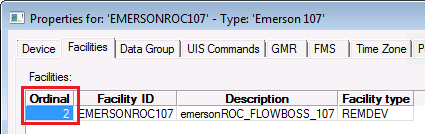
If necessary, edit the target device's facility ordinal value to match that of the source device. Once you have verified that the facility ordinal values are the same, proceed to copying desired data groups using the utility. For more information, see Data Group Ordinals and Facility Ordinals.

Using the CygNet DDS Data Group Copy Utility involves deciding which data groups you want to copy to which remote device(s) and with what effects on the destination remote device(s).
Specifically, use the CygNet DDS Data Group Copy Utility to add, update, replace, and delete data groups. The difference between updating a data group and replacing a data group is that with updating you can specify a subset of items to update within the data group, whereas replacing the data group is identical to deleting the data group and adding it again.
When the Add/Update or Update Only options are selected in the Copy Options area, Update Options become available. You can select to update any or all of these items. If none of these items are selected, no changes are made to the data group in the destination remote device.
To Copy Data Groups
Note: Best practice recommends copying data groups in Test Mode Only first. Then, when you are ready to copy to a live remote device, copy to a single remote device and verify your results before copying to multiple remote devices.
Note: Best practice recommends selecting only one remote device for your first live copy.
To Select Specific Data Group Elements for Copy

The following table provides details about the properties of the CygNet DDS Data Group Copy dialog box.
| Property | Description |
|---|---|
| General | |
|
Copy |
Click to perform a copy of all selected data groups within the Data Groups to Copy field. |
|
Close |
Click to close the CygNet DDS Data Group Copy dialog box. |
|
Test Mode Only |
Check to enable Test Mode. When running in Test Mode, the status bar towards the bottom of the dialog box identifies the action as SIMULATION. The numbers next to each operation are the elapsed processing time in seconds. |
|
Copy Log to Clipboard |
Click to copy a log to the clipboard for output to a text file of your choice. |
|
Clear |
Click to clear the copy log between copies. |
| Copy From | |
|
DDS Site.Service |
The site and DDS service from which you want to copy data groups or some of their properties. |
|
Device ID to Copy |
The device ID of the remote device you want to use as your data group source remote device. |
|
Data Groups to Copy |
This field lists all data groups individually or by type for a specified device ID. Includes ordinal, description, and facility. |
|
Load Data Group List |
Click to display all data groups individually or by type for a specified device ID. |
|
List Data Group Types |
Check to sort and display data groups by type for a specified device ID. If you have several individual data groups of a certain type, this setting collapses them all into a single group. |
| Copy To | |
|
All devices where type matches device ID to copy |
All remote devices of the same remote device type as the source device. This is the most common option. |
|
All devices of type |
All remote devices of a designated type, but which are not the same as the source remote device type. Note: When copying data groups from one remote device type to another, be sure that the destination device(s) support the copied data groups. Copying from one type to another is usually only valid for remote device types from the same manufacturer or for user-configured remote devices, like Modbus remote devices. |
|
Selected devices |
A list of specific, individual remote devices. Multiple individual devices can be selected at once. Note: When copying data groups from one remote device type to another, be sure that the destination device(s) support the copied data groups. Copying from one type to another is usually only valid for remote device types from the same manufacturer or for user-configured remote devices, like Modbus remote devices. |
|
Imported devices |
|
| Copy Options | |
|
Add/Update |
If a source data group is present in the destination device, update the data group. Otherwise, add the data group. Selecting this option enables Update Options. |
|
Update Only |
If a source data group is present in the destination device, update the data group. Otherwise, do nothing. Selecting this option enables Update Options. |
|
Add Only |
Add the source data group to the destination remote device if it does not already exist. If it does exist, do nothing. |
|
Add/Replace |
If a source data group is present in the destination remote device, replace the data group with the source data group. Otherwise, add the data group. |
|
Replace Only |
If a source data group is present in the destination remote device, replace the data group with the source data group. Otherwise, do nothing. |
|
Delete |
If a source data group is present in the destination device, delete the data group from the destination device. Otherwise, do nothing. |
| Update Options | |
|
Description |
Check to update the destination data group description with the source data group description. |
|
Hidden State |
Check to update the destination data group hidden state with the source data group hidden state. See Hide Data Group for more information about this property. |
|
TxRetention |
Check to update the destination data group transaction retention settings with the source data group transaction retention settings. See Transaction Retention for more information about this property. |
|
TxReplication |
Check to update the destination data group transaction replication attribute with the source data group transaction replication attribute. See Transaction Replication for more information about this property. |
|
Web Enabled |
Check to update the destination data group Web enabled status with the source data group Web enabled status. See Web Accessible for more information about this property. |
|
Security Info |
Check to update the destination data group security settings with the source data group security settings. See Device Operational Security for more information about this property. |
|
Metadata |
Check to update the destination data group metadata with the source data group metadata. |
|
Check to update the destination data group UDC mappings with the source data group UDC mappings. When copying a single data group and the UDC Data update option is checked, the Options button becomes enabled. |
|
|
Options |
When UDC Data is selected, click Options to access selection of specific UDC-mapped data group elements to update. Use this option to change or add UDC mappings to the destination device. For more information, see To Select Specific Data Group Elements for Copy. |
The following table provides details about common error and warning messages of the CygNet DDS Data Group Copy dialog box.
| Message | Description |
|---|---|
| Error Message | |
|
DDS has uninitialized facility ordinals. Run DDS Load to correct. |
This message is displayed if a destination remote device has facilities for which the ordinal is -1. See CygNet DDS Import/Export Utility. |
|
Unable to load UDCs for selected data group. |
Occurs when the Options button is pressed, but no UDCs are mapped in the selected source data group. |
|
Advanced UDC Options unavailable if more than one From data group selected. |
Occurs when the Options button is pressed, but more than one data group is selected. Select one data group at a time to use advanced UDC options. |
| Log Error Message | |
|
You must have DDS Database administrator rights to run this program. |
This is a security issue. You must have administrator permission for the DDS ACCESS event to run this program. Contact your CygNet system administrator. |
|
No corresponding facility for device source device facility facility on device target device |
Occurs when a facility ordinal mismatch is detected between the source and target devices. The facility ordinals must be the same. |
| Log Warning Message | |
|
Unable to load metadata for data group data group Ordinal # on device device |
Occurs when Metadata is selected as an Update Option, but no metadata exists for data group. |
|
Unable to load UDCs for data group data group Ordinal # on device device |
Occurs when UDC Data is selected as an Update Option, but no UDCs are mapped for data group. |
|
No match for To/From Device facility facility in From/To Device device |
Occurs when no facility ordinal match is found in the target data group. |
|
|
|

